
Research & Engineering Case Study
Published Research: The Digital Experience Gap in Prescription Drug Websites
An independent study of the performance, accessibility, and usability of more than 300 U.S. prescription drug brand homepages.
My role
Research Lead & Software Engineer
I shaped the research question and measurement strategy, built the data pipeline and public benchmark, and carried the analysis through publication.
Published in Universal Access in the Information Society · Springer Nature · 2026
Read the published research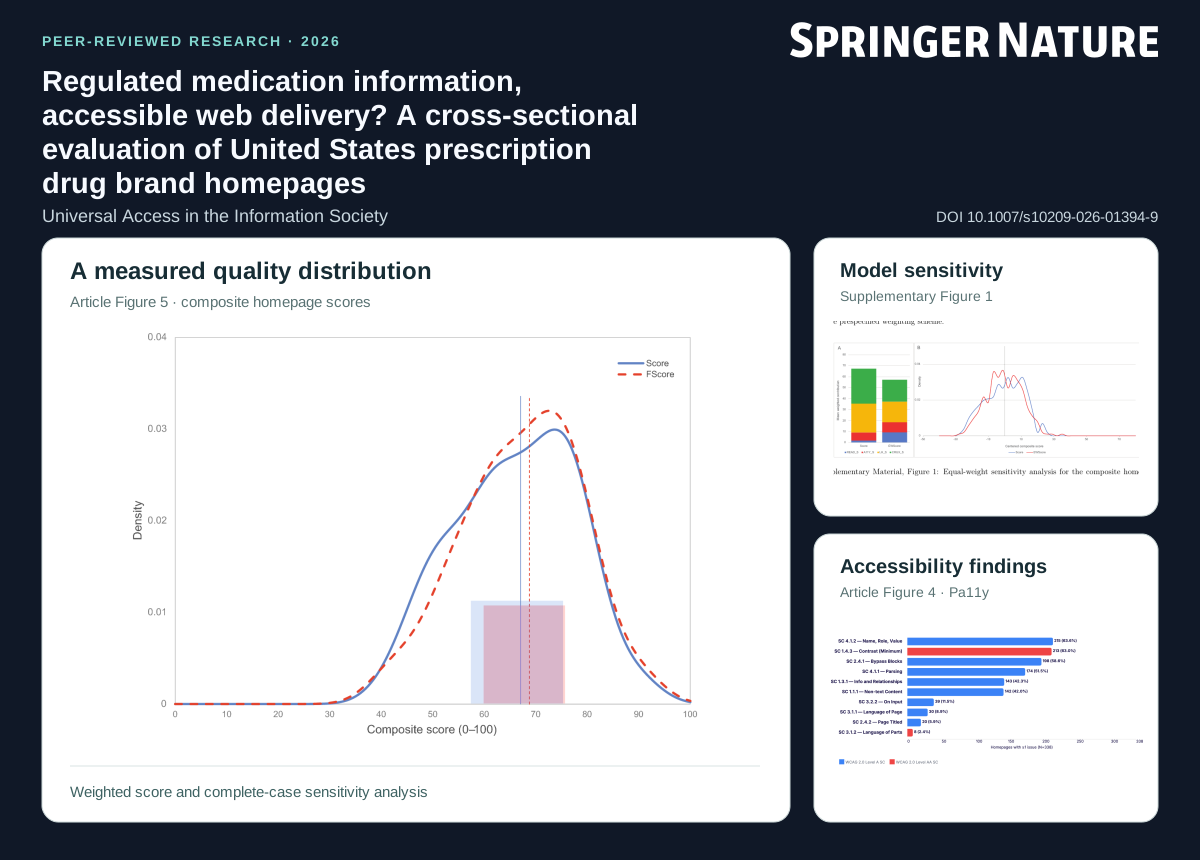
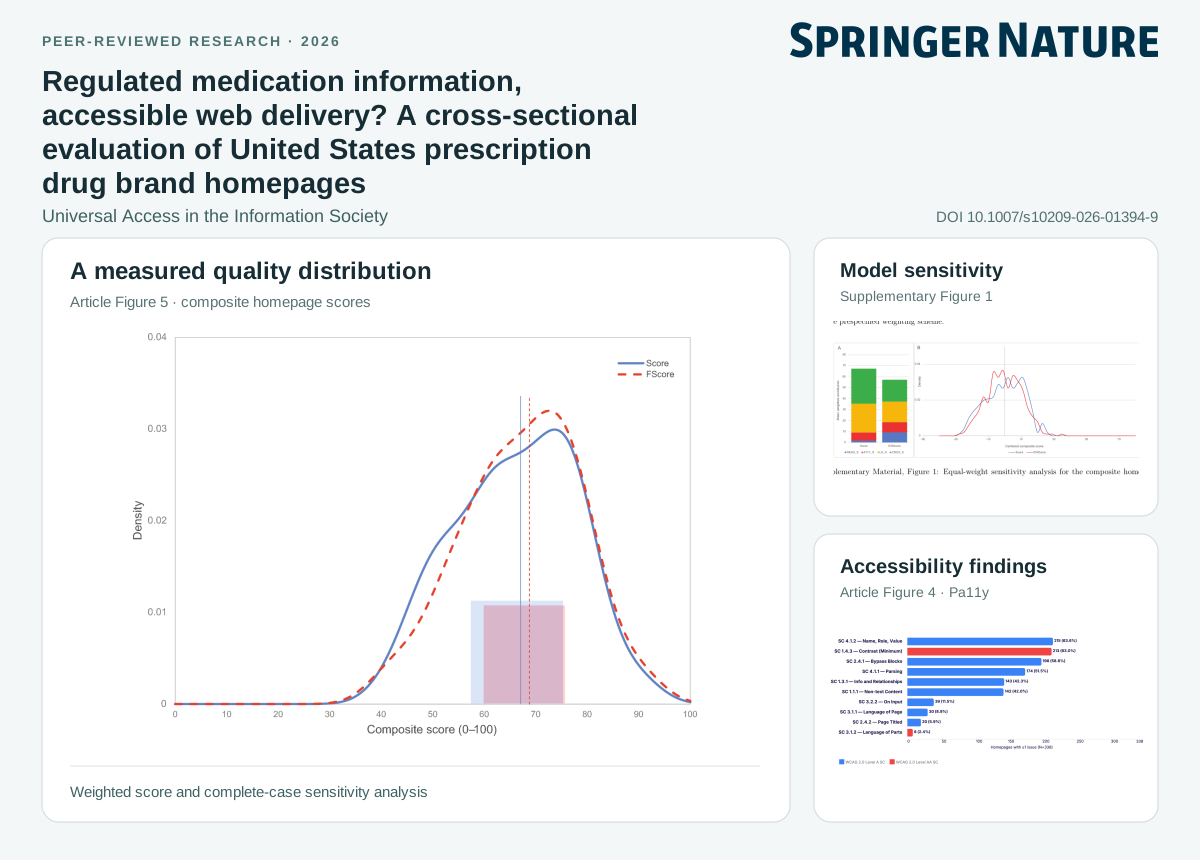
Image description
The hero combines the published research title and Springer Nature mark with three actual research figures: the distribution of composite homepage scores, a supplementary sensitivity analysis, and automated accessibility findings. The figures are reproduced from the open-access article and its supplementary material.
Figures from Shestov and Felix Brewer (2026), published in Universal Access in the Information Society; CC BY 4.0.
The Challenge
Regulated information still depends on the quality of its interface.
Prescription drug websites operate in a highly regulated content environment, yet the quality of the interface delivering that information is less clearly understood. I framed the project around a practical HCI question: how can we measure whether these entry points are fast, accessible, stable, and readable at scale?
Engineering & Research Approach
A connected measurement system, from source APIs to public evidence.
Built a JavaScript and Node.js pipeline combining mobile Lighthouse audits, Pa11y checks, CrUX API field data, and text extraction with Puppeteer and Mozilla Readability.
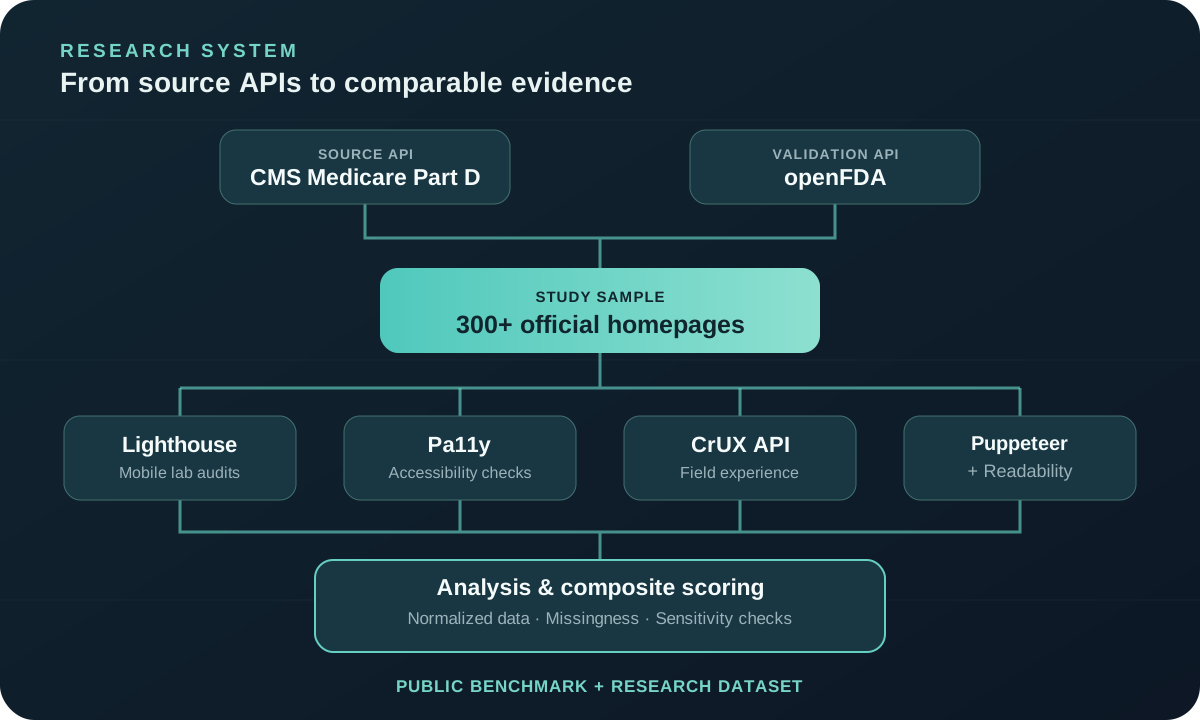
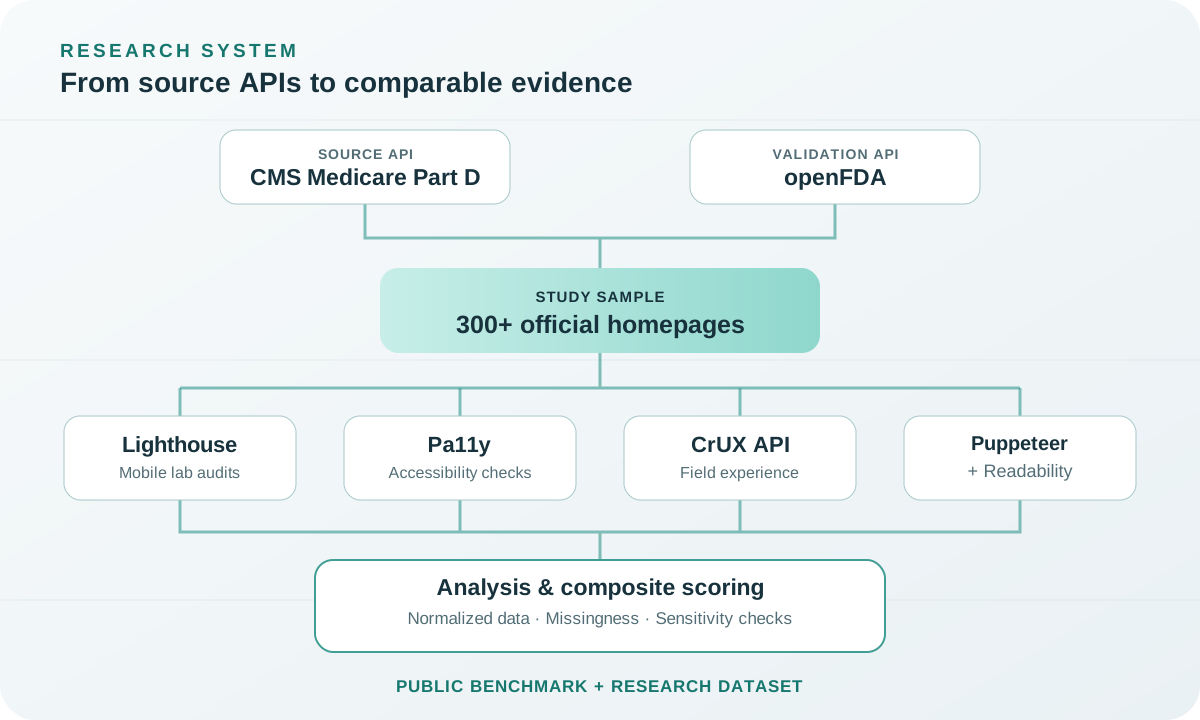
Image description
The diagram starts with CMS Medicare Part D and openFDA APIs, which establish and validate a sample of more than 300 official homepages. Lighthouse, Pa11y, CrUX API, and Puppeteer with Mozilla Readability provide measurements that feed normalization, missing-data handling, composite scoring, and the public benchmark.
One study sample connected source APIs, four measurement methods, and the public benchmark.
01
Data collection & validation
Connected the CMS Medicare Part D and openFDA APIs to establish a defensible study sample, then aligned the selected brands with their official patient-facing homepages.
02
Statistical analysis
Joined the measurements by homepage, normalized four quality dimensions, and designed a weighted benchmark with explicit treatment of missing data and sensitivity checks.
03
Visualization & reproducibility
Published an explorable SvelteKit benchmark alongside the research code, analytic dataset, and documented methods so others can inspect the evidence.
Findings & Impact
The benchmark exposed a gap in digital delivery quality.
Automated accessibility results flag potential barriers; they do not establish WCAG conformance or directly measure patient comprehension.
300+
Official homepages analyzed
56/100
Median mobile Lighthouse Performance
2.7%
With zero automated Level A findings
Collaboration & Publication
Research, engineering, and medical context in one published study.
I led the research concept, methodology, software, data collection, analysis, and visualization. The project required technical ownership as well as judgment about what the measurements could—and could not—support.
My co-author, Christopher Felix Brewer, contributed medical-domain perspective, helped check the interpretation of findings, and helped make the technical results clear to healthcare readers.